
Guideline
The diagram below meticulously depicts the seamless workflow for lead conversion and the intricacies of partner backend interactions within the Muse Finance ecosystem. The process unfolds through strategic interactions with the Muse Finance API, orchestrating the efficient management of leads, notifications, and backend processes.
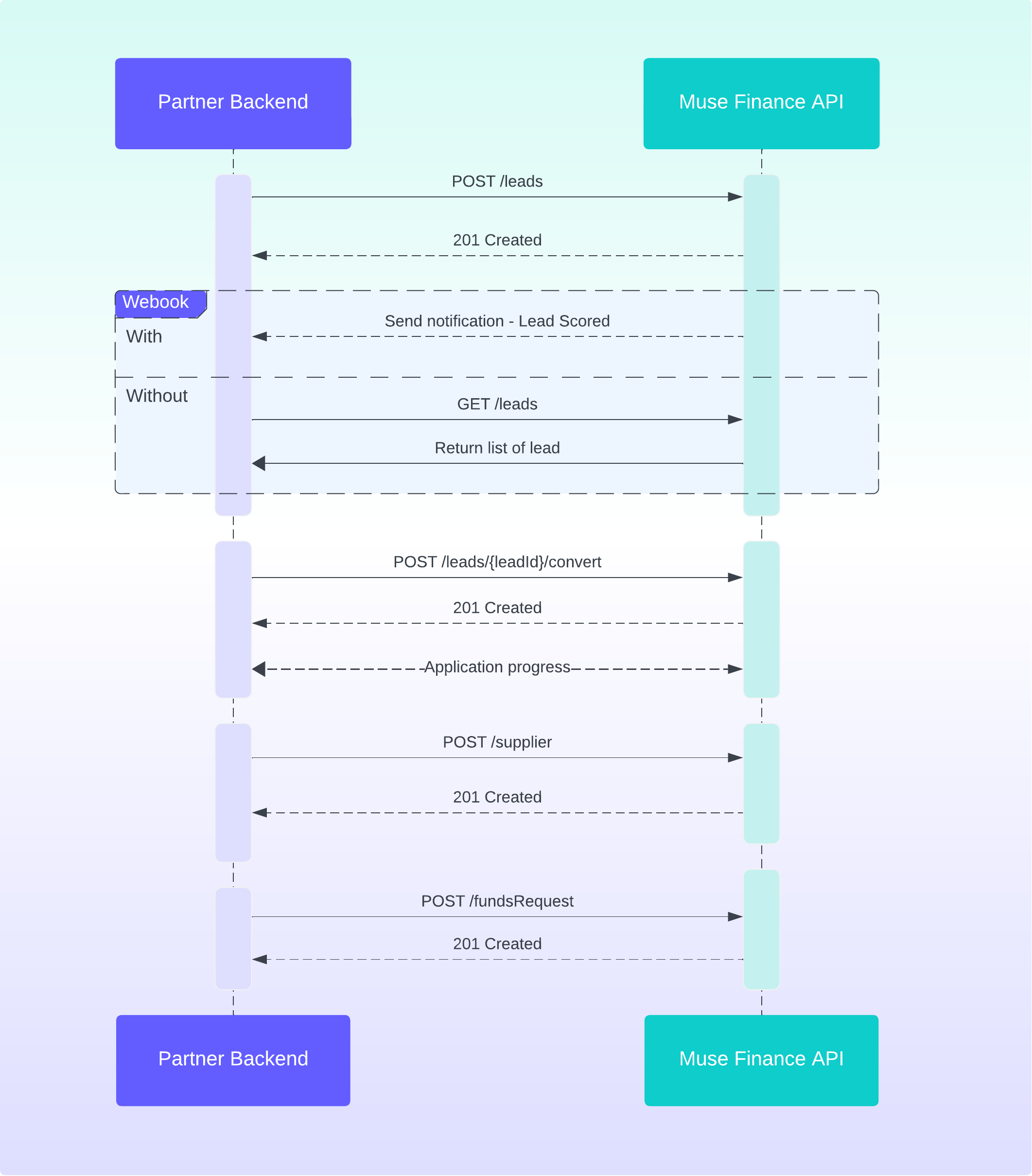
The Journey from Lead to Release of Funds in a Supply Finance Agreement
Steps
Step 1: Submit a Lead
Description
Initiate the Journey: Embark on the process by submitting a new lead to the Muse Finance API through a well-crafted
POSTrequest to/leads.
Discover Lead Insights: Optionally, delve deeper into lead insights by making a
GETrequest to/leadsand retrieve a comprehensive list of leads.
Dynamic Scoring and Notifications (Optional): If the partner has opted for webhook notifications and the lead undergoes scoring, the system triggers a notification, ensuring a dynamic and responsive environment.
Regular Lead Checks: If webhook notifications are not opted for, the partner needs to perform regular lead checks by making
GETrequests to/leadsfor updated information.
Validation and Confirmation: Receive a prompt
201 Createdresponse, affirming the successful submission and validation of the lead.
Step 2: Convert a Lead
Description
Transformational Process: Propel the lead along its journey by initiating the conversion process using a
POSTrequest to/leads/{leadId}/convert.
Acknowledgement of Success: Bask in the affirmation of success as a 201 Created response acknowledges the successful conversion, paving the way for further actions.
Step 3: Webhooks Subgraph
Description
With Webhook
Intricacies of System Interaction: Engage in meticulous interactions with the Muse Finance API, orchestrating a symphony of webhooks to notify and respond to relevant events within the system.
Real-time Intelligence: Stay informed with real-time intelligence as webhooks notify significant events such as lead conversions and other pivotal activities.
Without Webhook
Partner Decision: Partners have the option not to utilise webhooks for real-time notifications.
Regular Checks for Lead Updates:
Action: Engage in meticulous interactions with the Muse Finance API by making periodic
GETrequests to/leads.Purpose: Orchestrate a systematic approach to obtain lead updates and relevant information.
Timing: Asynchronously check for lead conversions and other pivotal activities.
Strategic Decision-Making: Empower the partner with real-time intelligence by staying informed about significant events such as lead conversions through regular API checks.
Step 4: Partner Backend Workflow
Submit Supplier Information
Description:
Commence Backend Processes: Ignite the backend workflow by initiating a
POSTrequest to/supplier, and submitting essential supplier information.
Backend Processing: Delve into backend processes, leveraging the supplied information for further backend operations and enhancements.
Submit Funds Request
Description
Backend Continuation: Seamlessly continue the backend workflow with a
POSTrequest to/fundsRequest, setting in motion the funds request process.
Awaiting Responsiveness: Relevant responses within the backend processes, ensuring a harmonious orchestration of financial transactions.
Overall Summary
The Muse Finance API serves as the central nervous system of this sophisticated orchestration, offering a robust framework for lead conversion, real-time notifications, and seamless facilitation of partner backend processes.
This API empowers partners with a suite of secure authentication mechanisms, ensuring the confidentiality and integrity of data.
Strategic adherence to the specified endpoints for each action guarantees a harmonious integration, fostering an ecosystem where partners can confidently navigate lead management, receive real-time insights, and orchestrate backend workflows with precision.